

In a perfect world, relationships would feel like two whole people walking side by side, choosing each other every day.
In real life… we often slide into extremes:
- Clinging so tightly we can’t breathe
- Or pulling so far back no one can really reach us
This is the difference between codependence, independence, and interdependence.
And learning to move toward interdependence is one of the healthiest shifts you can make in love.
This guide is about that middle path:
how to stay close, loving, and connected without disappearing inside the relationship.

1. What Interdependence Actually Means
Interdependence isn’t “I don’t need anyone.”
It’s also not “I can’t function without you.”
Interdependence is:
- “I can lean on you, and you can lean on me.”
- “We’re a team, but we’re still two separate people.”
- “I love you deeply, but my entire identity doesn’t depend on your moods, attention, or approval.”
In an interdependent relationship:
- You both have lives, interests, and values outside the relationship
- You both feel safe to say no without fear of losing the other
- You care about each other’s feelings, but you don’t make each other responsible for your entire emotional world
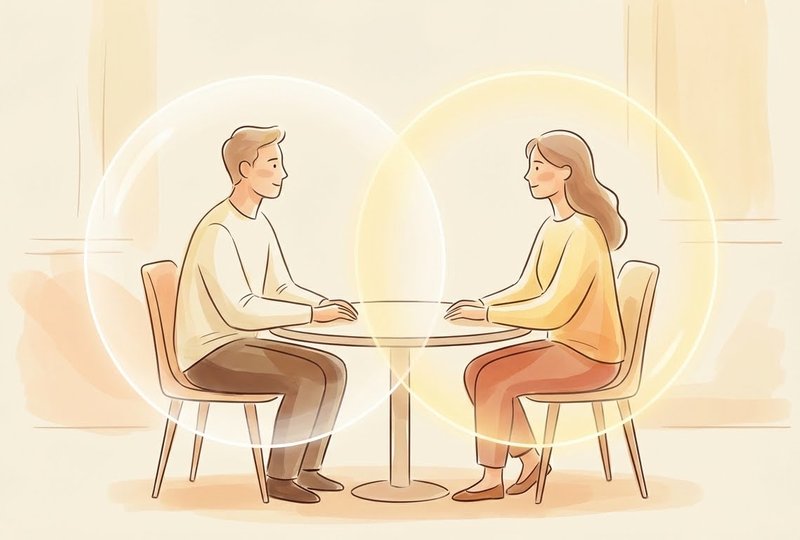
Think of it as two trees whose branches touch and intertwine, but whose roots are separate.

2. What Codependence Feels Like From the Inside
Codependence rarely starts with “I want to lose myself in this person.”
It often begins as:
- “I just want them to be happy.”
- “I want to be a good partner.”
- “I don’t want to cause conflict.”
Over time, though, it morphs into something heavier.
Common signs of codependence:
- You feel anxious if they’re not okay, and you rush to fix every emotion they have.
- You monitor their reactions constantly: “Are they mad? Did I say something wrong?”
- You say yes when you want to say no, then feel resentful.
- You feel guilty for having your own needs, boundaries, or preferences.
- You often think: “If they left, I don’t know who I’d be.”
- You stay in situations where you’re not respected or appreciated because you’re afraid of being alone.
Codependence turns love into a constant emotional performance:
“If I do everything right, they’ll stay. If I slip, I’ll lose them.”
That’s not love. That’s fear dressed up as devotion.

3. The Other Extreme: Hyper-Independence
On the flip side, there’s hyper-independence:
- “I don’t need anyone.”
- “I’ll handle everything myself.”
- “If I depend on someone, they’ll hurt me or leave.”
Hyper-independence often grows from old hurt:
- You needed people before and they weren’t there
- Your feelings were dismissed, mocked, or used against you
- You learned that counting on others = getting disappointed
So now you protect yourself by never needing anyone for anything.
The problem?
Real intimacy requires vulnerability.
If you never lean on your partner, never open up, never let them see you soft or struggling, the relationship can feel:
- Shallow
- One-sided
- Emotionally distant
You might look “strong,” but inside you’re lonely in a shared life.

4. The Middle Path: What Healthy Interdependence Looks Like
Interdependence is a practice, not a personality trait.
You can grow into it.
In an interdependent relationship, you and your partner can say, in different ways:
- “I can stand on my own feet.”
- “I also love standing next to you.”
- “I won’t collapse if you’re upset with me, but I care enough to listen and repair.”
- “My happiness is my responsibility, but sharing life with you adds to it.”
Daily signs of interdependence:
- You share feelings honestly, even when they’re messy.
- You respect each other’s time, space, and individuality.
- You can agree to disagree without it turning into a breakup threat.
- You both apologize and repair when you hurt each other.
- You can spend time apart without spiraling into panic or punishment.
It’s not drama-free. It’s honest, flexible, and grown.
5. Boundaries: The Skeleton of Healthy Love
You can’t have interdependence without boundaries.
A boundary isn’t a wall.
It’s a definition: “Where I end and you begin.”
Examples of healthy boundaries in relationships:
Time:
“I love talking to you, but I also need some alone time to recharge.”Communication:
“I’m willing to discuss conflicts, but I’m not okay with yelling or name-calling.”Personal life:
“You’re important to me, and I also want to keep some hobbies and friendships that are just mine.”Emotional responsibility:
“I care about how you feel, but I can’t be the only way you manage your stress or pain.”
When there are no boundaries, relationships turn into:
- Emotional fusion (“Your mood = my mood”)
- Silent resentment (“I keep saying yes, but I’m exhausted”)
- Confusion (“I don’t even know what I want anymore”)
Boundaries are not selfish. They are how love stays clear and clean, instead of suffocating.

6. How to Shift from Codependence to Interdependence
If you recognize yourself in codependent patterns, you’re not broken.
You’re someone who learned to survive by over-giving, over-fixing, and over-merging.
You can learn a new way.
1. Start noticing when you abandon yourself
Ask yourself during the day:
- “Where did I say yes but mean no?”
- “Where did I stay silent even though something hurt?”
- “Where did I ignore my own needs to avoid conflict?”
You can’t change what you don’t see. Awareness is step one.
2. Practice tiny acts of honesty
You don’t have to start with huge conversations.
Try:
- “Actually, I’m a bit tired tonight. Can we reschedule?”
- “When you joked about that earlier, it stung a little.”
- “I’d really like some alone time this afternoon, but I still care about you.”
Small truths build self-respect and trust.
3. Separate love from caretaking
You might equate love with “fixing”:
- calming every mood
- predicting every need
- absorbing every emotion
Ask yourself:
“If I stopped managing their feelings… would there still be a relationship here?”
Love is support, not self-erasure.
You can be kind without carrying everything.
4. Build a life that isn’t only about the relationship
Interdependence needs multiple roots, not just one.
Nurture:
- Friendships
- Hobbies
- Career or studies
- Personal goals
- Your physical and mental health
A relationship should add richness to your life, not be the only source of it.
5. Learn to tolerate discomfort
Setting boundaries, saying what you feel, not fixing everything immediately…
all of this will feel uncomfortable at first.
You might feel guilty.
You might fear rejection.
Your nervous system may scream: “This is dangerous, go back to pleasing!”
But discomfort is not danger.
It’s often the feeling of old patterns breaking.
Take small steps. Breathe through it. Let your body learn that honesty and boundaries can be safe.

7. What to Do If Your Partner Resists Your Growth
Sometimes, when you start changing, the relationship shows its true shape.
If your partner reacts to your growth with:
- Mockery: “Wow, you’re so selfish now.”
- Punishment: Silent treatment when you say no.
- Threats: “If you don’t do this, maybe we shouldn’t be together.”
- Control: “You don’t need friends; I’m all you need.”
…then your shift toward interdependence is revealing how unequal things really were.
Healthy partners may feel surprised or uncomfortable at first, but they eventually say things like:
- “I didn’t know you felt that way. Let’s talk.”
- “I’m not used to this, but I want to understand.”
- “If this is important to you, I want to try.”
If your growth is constantly punished, you’re not in a relationship.
You’re in a system that requires your self-abandonment to function.

8. Loving Without Losing Yourself
Real love doesn’t ask you to vanish.
It invites you to show up fully.
Interdependence sounds like:
- “I choose you, but I also choose me.”
- “I’m willing to bend, but not to break myself in half.”
- “I can love you deeply without making you my entire identity.”
You deserve a relationship where:
- closeness doesn’t cost you your self-respect
- compromise doesn’t mean constant self-sacrifice
- love feels like a soft place to land, not a maze you’re always trying to solve
Loving without losing yourself is not a fantasy.
It’s a skill, learned step by step, boundary by boundary, truth by truth.
And you are allowed to start practicing it today.


